.png)
A major new battery incentive for NSW businesses begins on 1 September 2026.
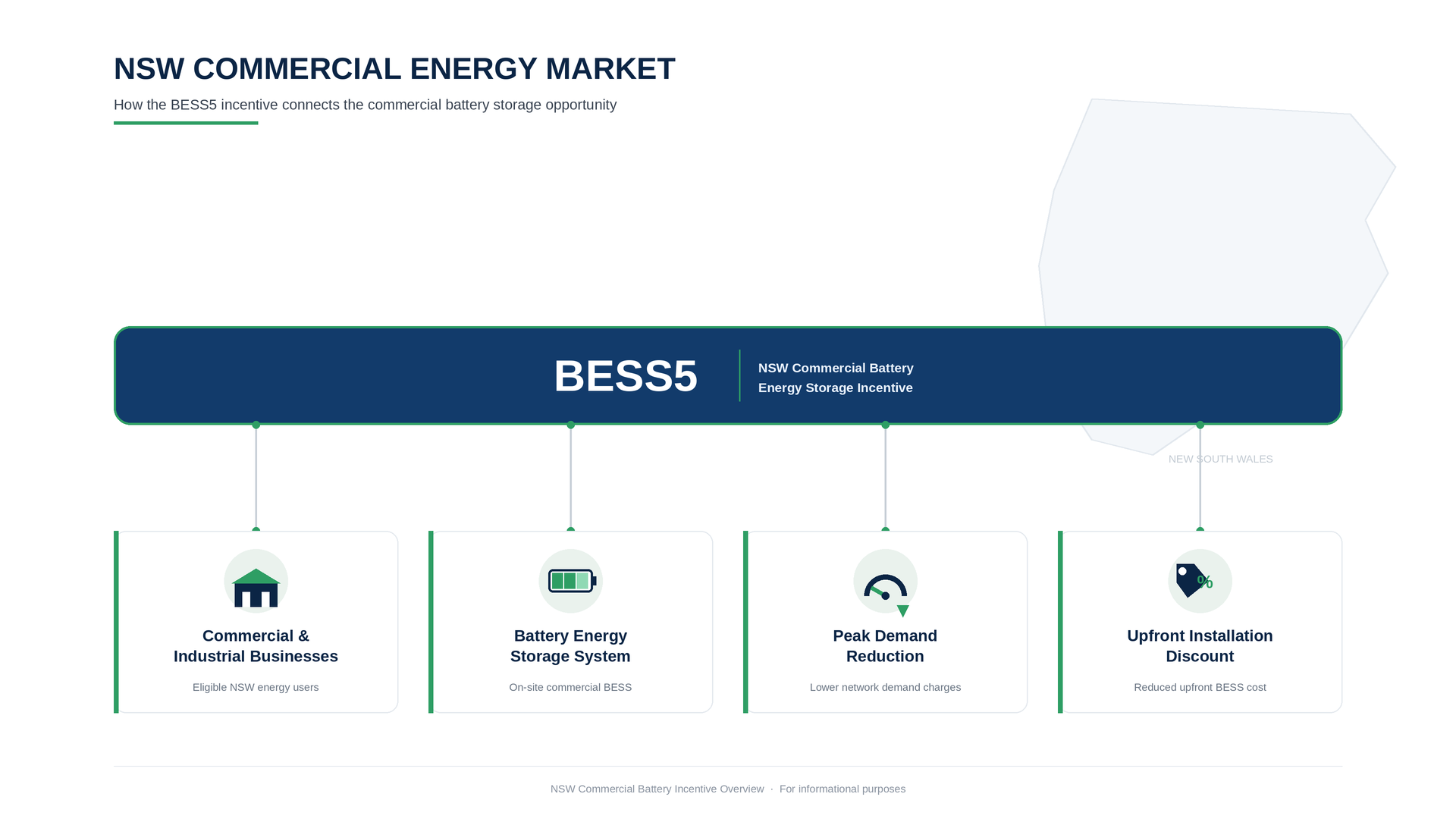
Known as BESS5, the new activity forms part of the NSW Peak Demand Reduction Scheme (PDRS) and is specifically designed for commercial and industrial battery installations.
For businesses already considering battery energy storage — particularly warehouses, factories, agricultural operations and other high-energy-use sites — the incentive could materially reduce the upfront investment required.
The NSW Government says eligible businesses may receive approximately 20–40% off battery installation costs, depending on the project, with larger discounts available in certain circumstances when new battery capacity is installed alongside new or additional solar.
Here's what businesses need to understand before making an investment decision.
What Is BESS5?
BESS5 is a new battery activity under the NSW Peak Demand Reduction Scheme.
It commences on:
1 September 2026.
Unlike smaller battery incentives, BESS5 has specifically been designed for:
commercial and industrial businesses.
The scheme creates incentives for qualifying battery installations that can contribute to reducing electricity demand during peak periods.
In practice, the financial benefit is generally expected to be incorporated into the commercial arrangement for the project, commonly reducing the effective upfront investment for the customer.
How Large Does a BESS5 Battery Need to Be?
This is where businesses need to be careful.
The detailed BESS5 rules specify that eligible commercial and industrial batteries must have a combined usable battery capacity greater than 200 kWh and no more than 30,000 kWh (30 MWh).
The incentive applies only to the first 10,000 kWh (10 MWh) of eligible battery capacity.
That means BESS5 is aimed at genuine commercial and industrial storage projects rather than typical residential batteries.
The NSW Government's broader business-battery program information references incentives across a wider range of business battery sizes, so businesses should have their project assessed under the specific activity that applies to their installation rather than assuming every commercial battery falls under BESS5.
Who Is BESS5 Designed For?
Potential applications include:
Manufacturing facilities
Warehouses and distribution centres
Food processing operations
Cold storage and refrigeration facilities
Agricultural businesses
Large commercial properties
Industrial facilities
Sites with substantial electricity consumption, high peak demand or significant solar generation may be particularly worth assessing.
.png?width=2240&height=1260&name=Blog%20Banner%20for%20Website%20Content%20(13).png)
How Much Is the NSW Commercial Battery Incentive?
There is not one fixed rebate amount that every business receives.
The NSW Government says eligible business battery discounts can be approximately:
20–40% of installation costs, depending on the circumstances.
The government also states that the discount can be larger when a battery is installed together with new or additional solar capacity.
The actual incentive depends on factors including the battery system, usable capacity, solar configuration and applicable scheme calculation.
This is important because businesses should be cautious of advertisements promising a universal dollar-value "commercial battery rebate."
A proper project assessment needs to calculate the applicable incentive for the proposed system.
Why Is NSW Incentivising Commercial Batteries?
Electricity networks need to accommodate periods where demand becomes particularly high.
Commercial batteries can help shift electricity consumption away from those peak periods.
For an individual business, the battery may also provide financial value by:
storing excess solar generation
instead of exporting all of it to the grid;
shifting energy consumption
from expensive periods to lower-cost periods;
reducing peak grid demand
where tariff structures make that valuable;
and potentially providing
backup or resilience
where the system is specifically designed and configured to do so.
.png?width=2240&height=1260&name=Blog%20Banner%20for%20Website%20Content%20(14).png)
Key BESS5 Eligibility Requirements
BESS5 isn't simply a rebate for purchasing any large battery.
Current scheme requirements include several important conditions.
Eligible batteries must meet the specified usable-capacity range and cannot be installed in a residential building or data centre under BESS5.
The battery must also satisfy specified relationships between battery capacity, inverter output and new solar PV capacity.
Systems must be internet connectable and controllable by a Demand Response Aggregator.
The battery must have been tested in accordance with UL 9540A requirements specified by the scheme.
Installations must satisfy the relevant network connection requirements.
They must be installed by an appropriately licensed person and comply with relevant standards and legislation.
Projects must also have the necessary planning and network approvals.
Because commercial battery projects can involve substantial electrical, fire, network and planning considerations, eligibility should be checked during project development rather than after equipment has been purchased.
BESS5 + New Commercial Solar
One of the most interesting opportunities in 2026 is the interaction between battery and solar incentives.
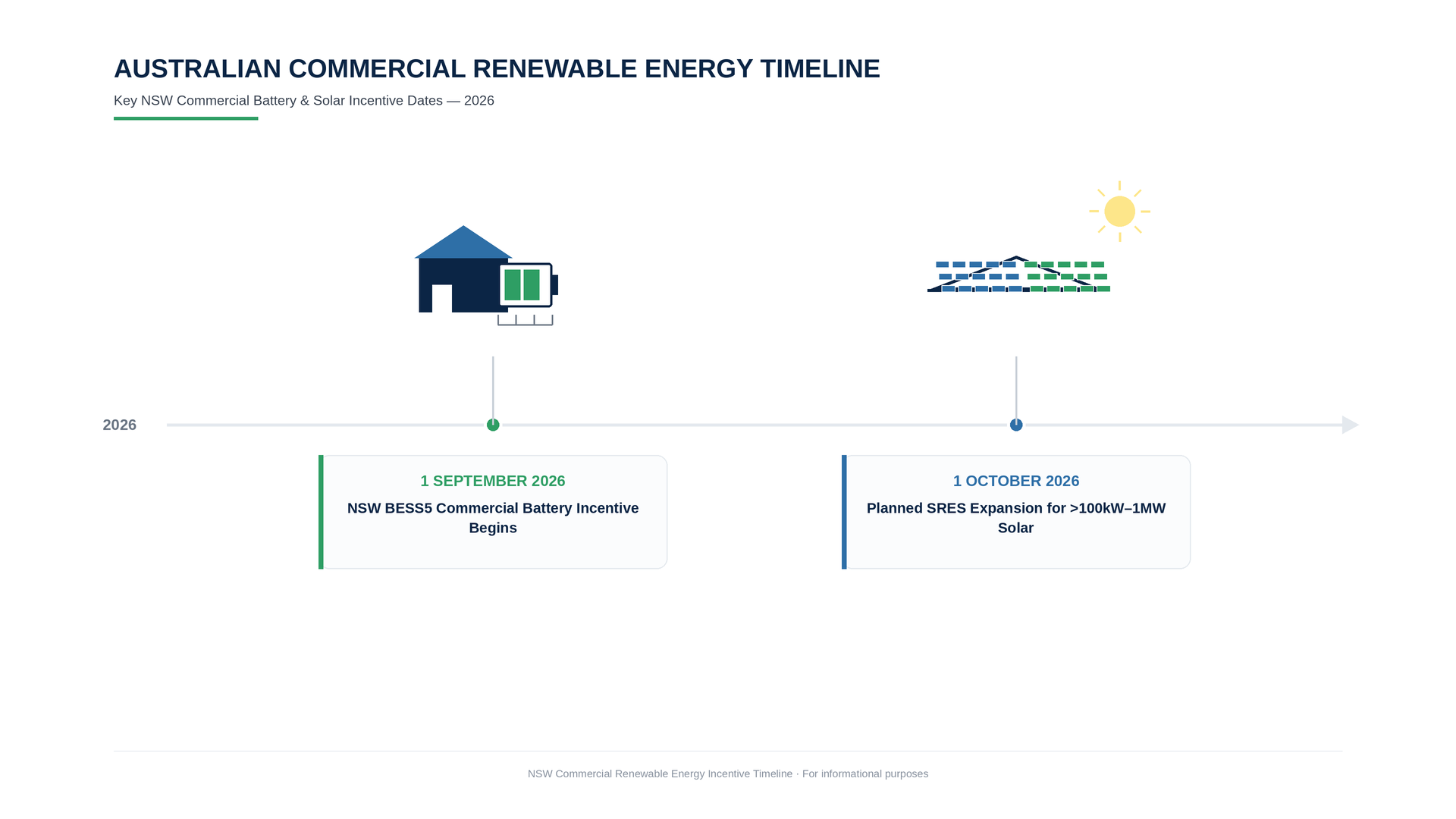
From 1 September, eligible NSW commercial battery projects can access the new business battery incentive.
Then, from 1 October 2026, the Australian Government intends to expand the SRES to eligible solar PV installations above 100 kW and up to 1 MW, subject to regulations being made.
The NSW Government has specifically indicated that its commercial battery discount can be larger when new battery capacity is installed alongside new or additional solar.
For suitable businesses, this creates a reason to evaluate the entire site's energy infrastructure together.
Should You Install Solar and Battery Together?
Possibly — but it should be modelled.
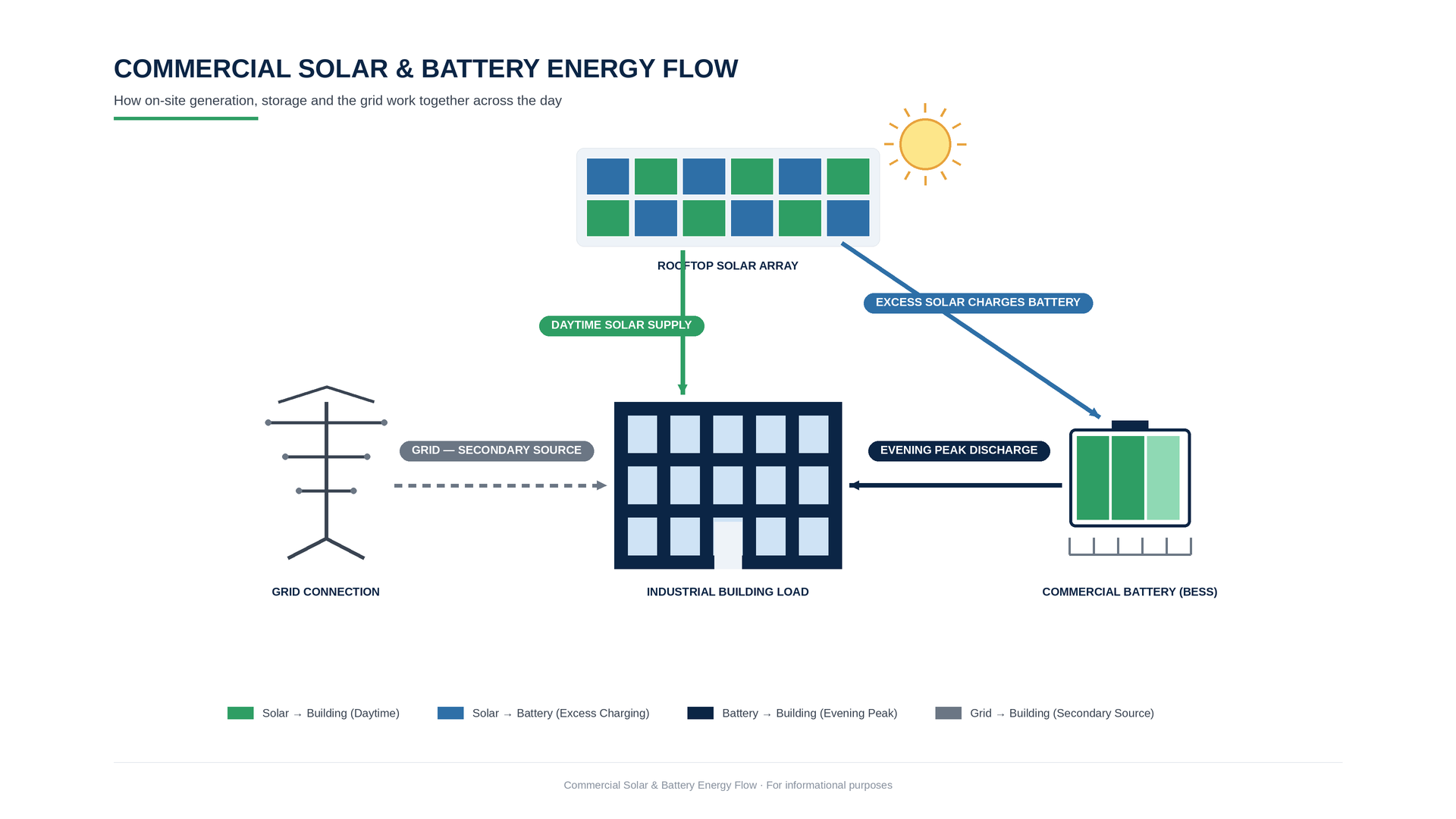
Consider a commercial facility with a large rooftop solar installation.
During the middle of the day, solar production may exceed the site's electricity demand.
Without storage, that electricity may be exported.
With an appropriately sized battery, some of that excess energy could instead be stored and used later when:
solar generation falls, electricity demand increases or electricity becomes more expensive.
But installing an oversized battery purely because an incentive is available can produce a poor investment.
The correct question is:
What combination of solar capacity, battery capacity and inverter power produces the strongest commercial outcome for this particular site?
What Information Should a Business Prepare?
Before requesting a serious commercial BESS proposal, gather:
12 months of electricity bills
and, where available,
interval-meter consumption data.
Also provide information about:
operating hours, major electrical loads, existing solar, planned solar, future expansion, critical loads requiring backup and any planned EV charging or electrification.
This allows the battery to be designed around the site's actual load profile rather than selecting capacity arbitrarily.
Don't Buy a Battery Because There's a Rebate
An incentive can improve the economics of an energy project.
It should not be the reason the project exists.
A commercial battery should solve an identifiable problem or create measurable value.
That might be:
lowering peak demand, increasing solar self-consumption, shifting electricity usage, supporting operational resilience or preparing a facility for future electrification.
The incentive then improves an already rational investment.
Considering a Commercial Battery in NSW?
The introduction of BESS5 makes 2026 an important year for commercial battery storage in NSW.
But commercial BESS projects require considerably more analysis than simply choosing a battery capacity from a product catalogue.
Ador Energy can assess your site's electricity data, existing or proposed solar, peak demand and operational requirements to determine:
Whether a battery makes sense, what capacity should be considered and which incentives may apply.
Speak with Ador Energy about a commercial solar and BESS feasibility assessment.