-1.png)
Can a Commercial Battery Actually Save Your Business Money?
Commercial battery storage is getting a lot of attention in Australia.
For NSW businesses in particular, interest is accelerating with the introduction of new commercial battery incentives from 1 September 2026.
But an incentive doesn't automatically make a battery a good investment.
The more important question is:
How will the battery actually save your business money?
For some businesses, the answer can be compelling.
For others, solar may deliver a stronger return on investment before battery storage is considered.
And for certain sites, the best outcome may come from designing solar and battery storage together.
A commercial battery can potentially create financial value in several different ways:
reducing peak demand, shifting electricity consumption, increasing solar self-consumption, reducing grid electricity purchases and, in some applications, providing resilience.
The NSW Government itself identifies reduced electricity costs, lower peak-demand charges and greater use of clean energy as potential sources of value from business battery storage.
The important part is understanding which of these actually applies to your site.
1. Peak Shaving: Reducing Your Highest Electricity Demand
One of the most important commercial battery applications is peak shaving.
A business doesn't necessarily use electricity at a constant rate throughout the day.
Consider a manufacturing facility.
For most of the morning it might operate at a relatively stable electrical load.
Then, at 2:00 pm:
a large compressor starts, refrigeration demand increases, production machinery operates simultaneously and the air-conditioning system is working heavily.
Electricity demand suddenly spikes.
A battery can be configured to recognise these periods and discharge energy to help reduce the amount of power being drawn from the grid.
Instead of the grid supplying the entire spike:
Grid + Battery → Business
This is known as peak shaving.
The Australian Government describes peak shaving as reducing electricity use at peak times and notes that it can help businesses manage maximum demand and optimise network and retail tariff costs.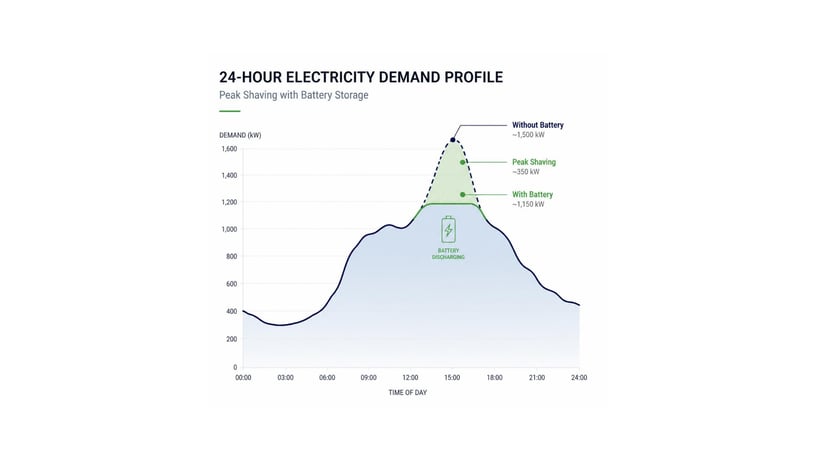
2. What Are Demand Charges?
This is where commercial electricity bills can become considerably more complicated than residential bills.
Some commercial electricity tariffs include a demand charge.
Rather than charging only for the total amount of electricity consumed in kilowatt-hours (kWh), part of the bill can be influenced by the business's maximum electricity demand, generally measured in kilowatts (kW) or kilovolt-amperes (kVA), according to the applicable tariff.
That creates an important distinction:
Energy consumption = how much electricity you use.
Demand = how much electricity you require at a particular point in time.
Imagine two factories each consume the same total amount of electricity during a month.
Factory A has relatively stable electricity demand.
Factory B regularly creates significant short-duration demand peaks.
Their total energy consumption may be similar, but depending on their tariffs, their electricity costs may not be.
That's why simply looking at the total dollar value on an electricity bill isn't enough when evaluating commercial BESS.
How Can a Battery Reduce Demand Charges?
Imagine a facility normally operates around:
250 kW
but occasionally reaches:
400 kW
during periods when several major electrical loads operate simultaneously.
If the site's tariff exposes it to costs associated with that peak, those relatively short periods can matter financially.
Now imagine a battery detects the site's load approaching a predetermined threshold.
The battery begins discharging.
Instead of drawing the entire 400 kW from the grid, perhaps the site receives:
300 kW from the grid
plus
100 kW from the battery.
The business is still consuming 400 kW.
But the grid sees a substantially lower peak.
That's the principle behind battery-based peak shaving.
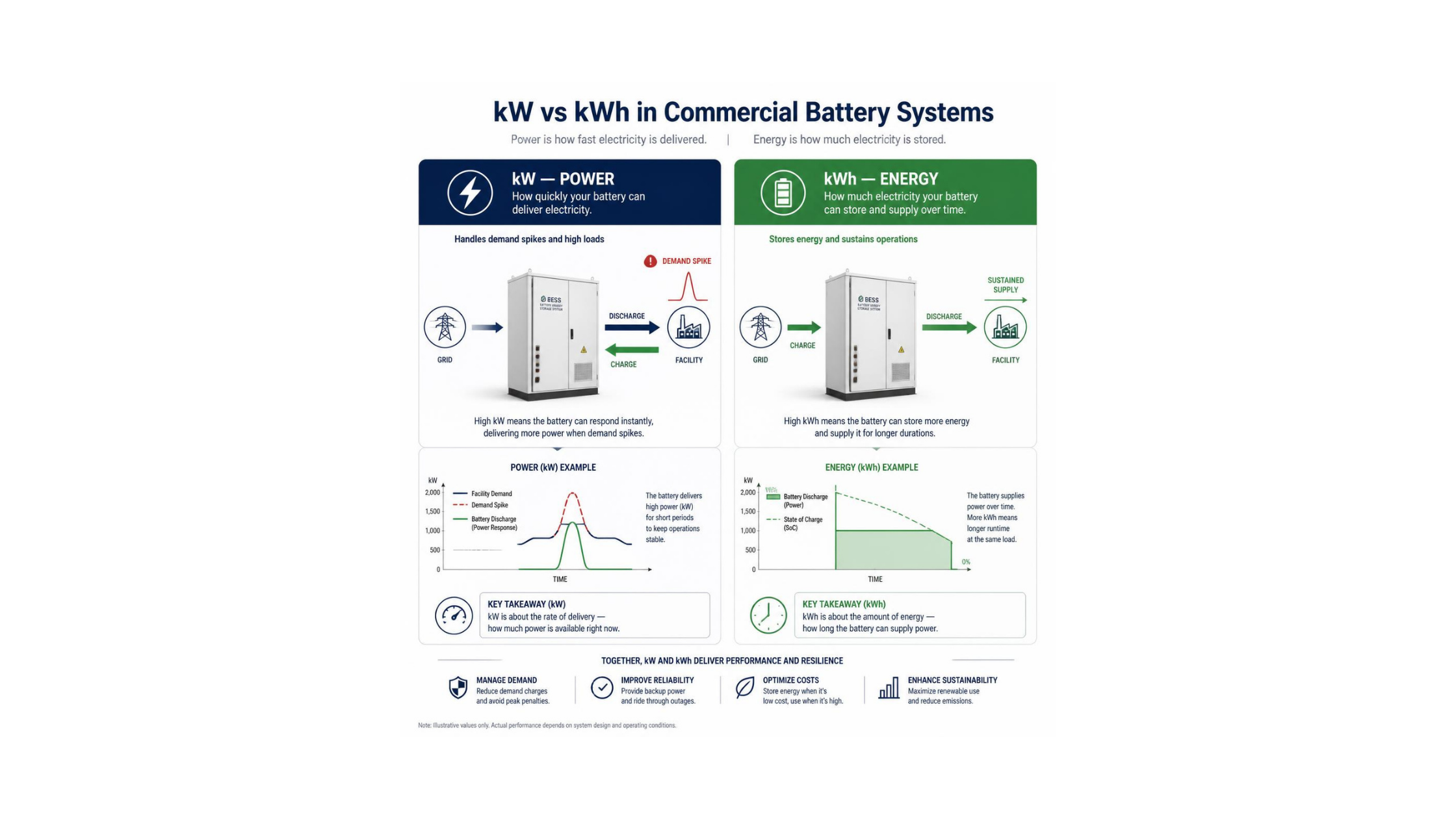
This is why battery power in kW can be just as important as battery energy capacity in kWh.
A battery might have plenty of stored energy but insufficient discharge power to effectively manage a large, sudden demand peak.
3. Solar Self-Consumption: Using More of the Energy You Generate
The second major commercial battery opportunity is solar self-consumption.
Imagine a warehouse has a large rooftop solar system.
At midday, solar generation may exceed the building's electricity consumption.
Without battery storage, that excess electricity may be exported to the grid, subject to the site's network arrangements.
Later in the afternoon or evening, solar generation falls.
But the business may still be operating.
It then begins purchasing more electricity from the grid again.
A battery changes that energy flow.
Instead of:
Solar → Business → Excess exported
the site may be able to operate more like:
Solar → Business
Excess Solar → Battery
then later:
Battery → Business
The Australian Government notes that batteries can store solar electricity for use when panels aren't producing enough or when electricity costs more, reducing the amount of electricity that needs to be purchased from the grid.

4. Energy Arbitrage: Store Electricity When It's Cheaper, Use It When It's Expensive
Another potential battery strategy is energy arbitrage, sometimes referred to more simply as energy shifting.
Where a business is exposed to electricity pricing that changes at different times, a battery can potentially:
charge when electricity is cheaper
and
discharge when electricity is more expensive.
For example:
Lower-cost period → charge battery
Higher-cost period → discharge battery
This doesn't automatically create an attractive return.
Battery losses, degradation, tariff structures and the difference between charging and avoided electricity costs all matter.
But for businesses with suitable tariff structures and predictable load patterns, energy shifting can become another part of the battery's financial value.
5. Solar + Peak Shaving + Energy Shifting Can Work Together
This is where commercial battery analysis gets more interesting.
A battery doesn't necessarily need to perform only one job.
A properly designed energy-management strategy might use the battery to:
charge from excess solar during the middle of the day
then
discharge to prevent an afternoon demand spike
and later
supply part of the facility's evening electricity consumption.
One asset is potentially contributing to several different energy objectives.
That's why we don't recommend assessing commercial batteries simply by asking:
How many kilowatt-hours of battery should we buy?
The better question is:
What is the battery being asked to achieve?
Once that is established, battery power, capacity and control strategy can be designed around the site's actual requirements.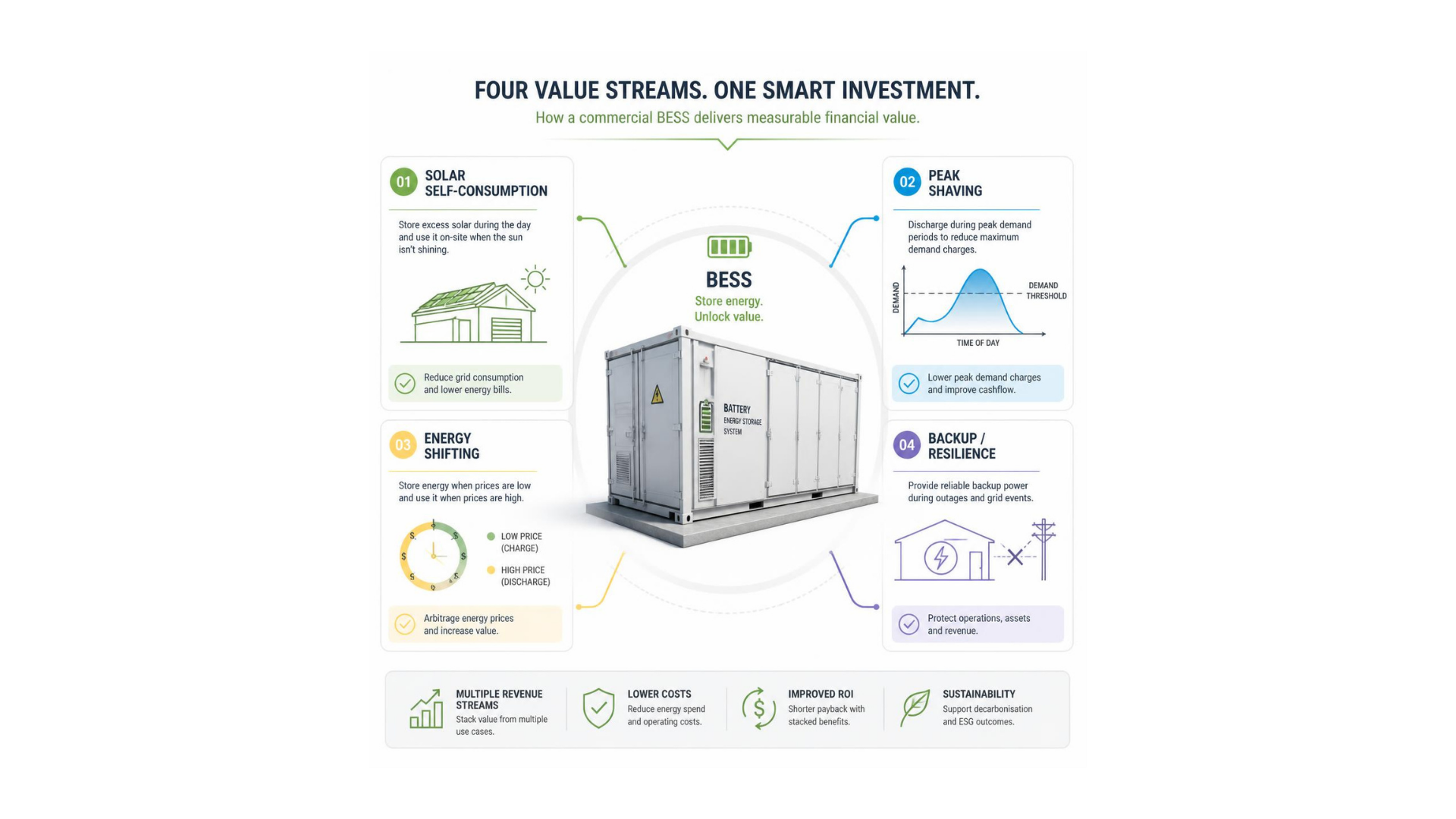
6. What About Backup Power?
Battery storage can also potentially improve energy resilience.
However:
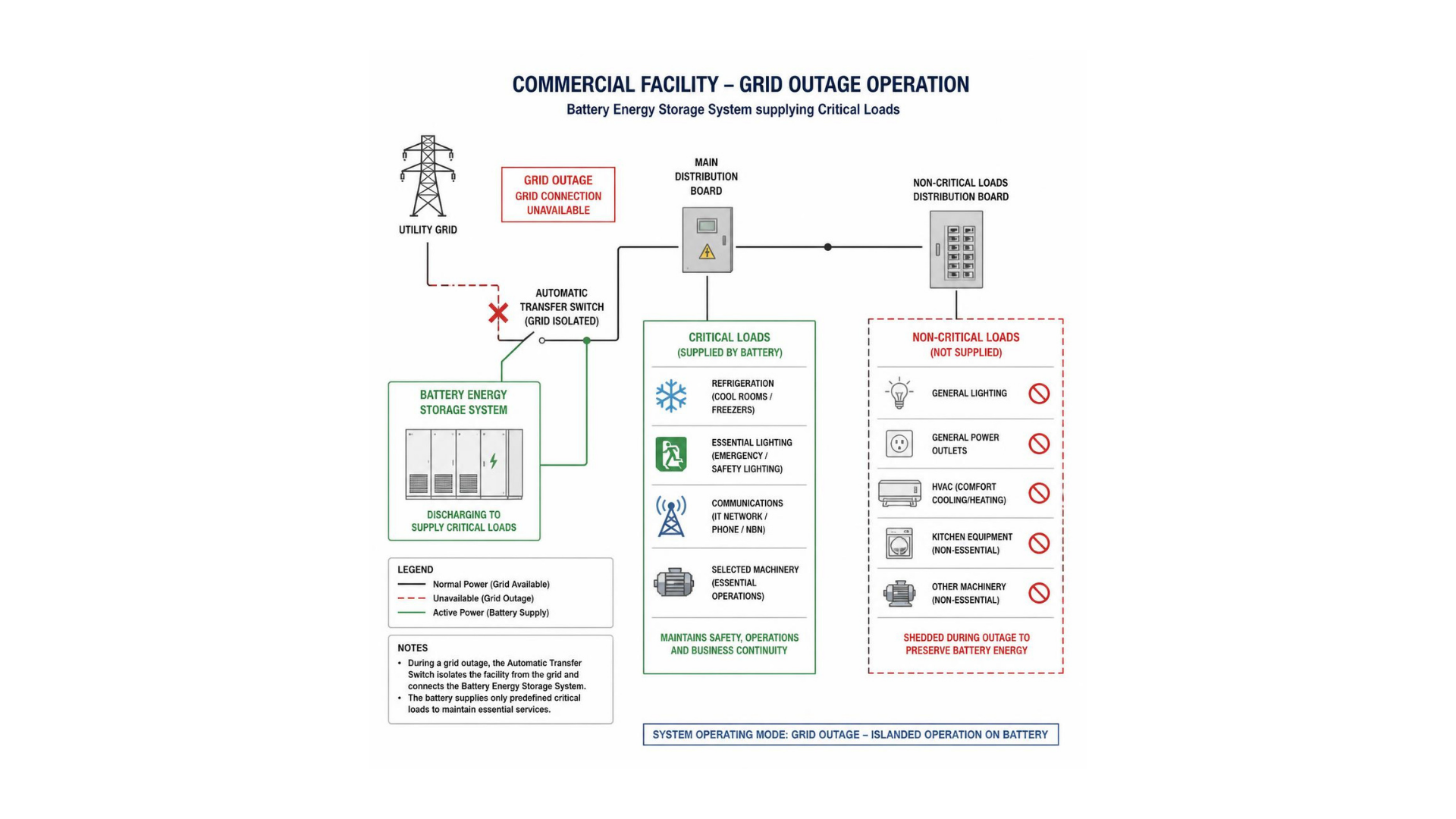
Having a battery does not automatically mean your business has backup power.
Backup capability depends on how the system is designed, including:
switchgear, controls, inverter capability, battery capacity, critical loads, network requirements and the electrical architecture of the facility.
For some businesses, backup capability may have substantial commercial value.
Consider:
cold storage, food processing, critical manufacturing, communications infrastructure or businesses where even short outages cause operational disruption.
In those circumstances, the financial value of a battery isn't necessarily limited to electricity-bill savings.
The business may also consider the cost of downtime avoided.
The NSW Government similarly notes that business batteries can keep power operating during outages where battery backup has been enabled.
7. Why Commercial Battery ROI Is Different for Every Business
This is perhaps the most important point in this article.
There is no universal answer to:
"What's the payback on a commercial battery?"
Two warehouses sitting next door to each other could install the same battery and achieve completely different financial outcomes.
Why?
Because their:
operating hours, electricity tariffs, solar generation, peak demand, load profile, export arrangements and energy-management strategy may all be different.
A battery quote without understanding those factors tells you the price of the equipment.
It doesn't necessarily tell you the value of the investment.
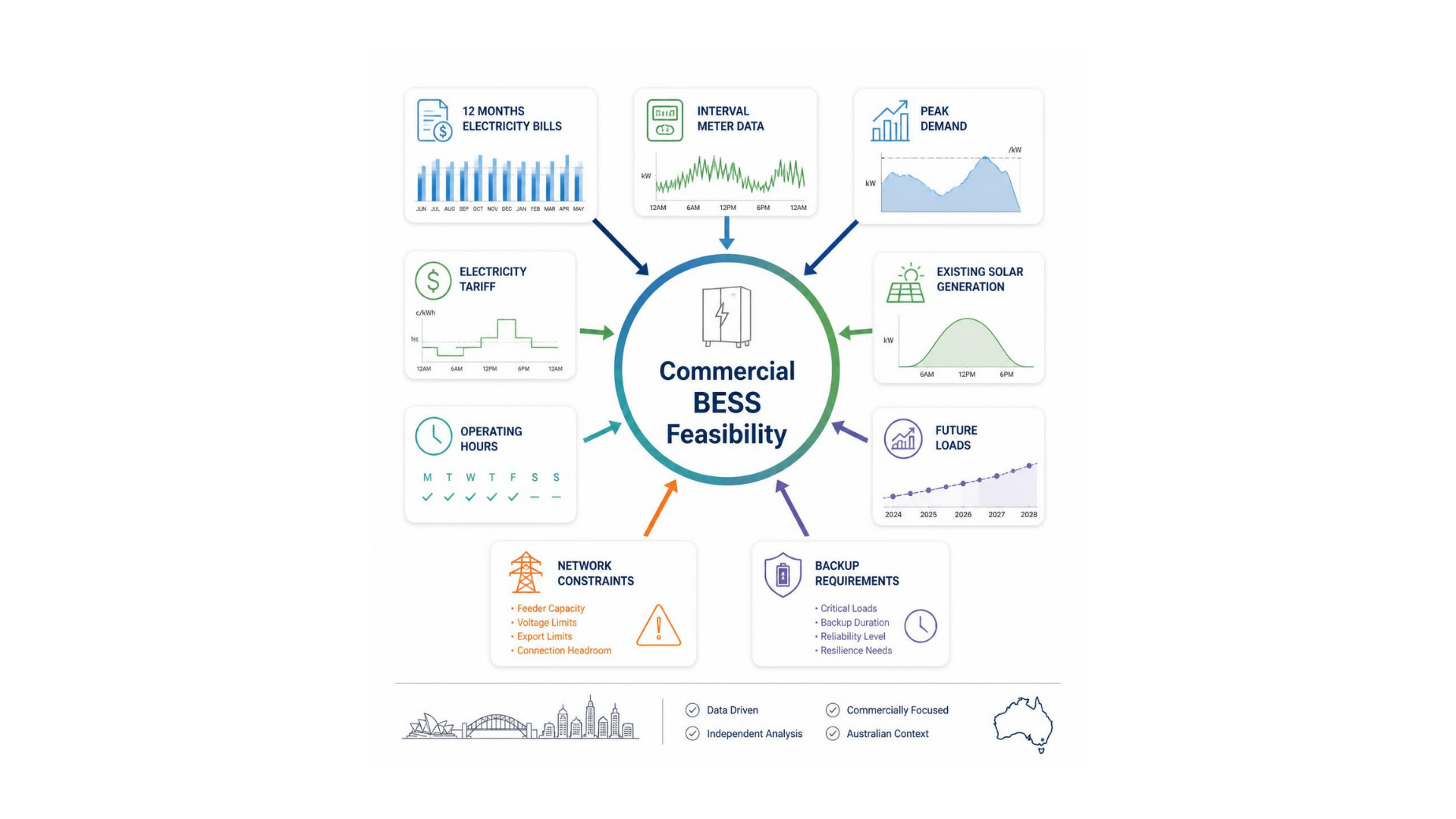
What Data Should Be Analysed Before Sizing a Commercial Battery?
For a serious commercial BESS feasibility assessment, we'd ideally want to understand:
12 months of electricity bills
This provides information around consumption, tariffs and costs.
Interval-meter data
This is particularly valuable.
Instead of simply knowing that a business consumed a certain number of kilowatt-hours in a month, interval data helps show when that electricity was consumed.
That allows us to identify:
peak demand events, daytime baseload, overnight demand, weekday/weekend differences and seasonal behaviour.
Existing solar generation
If solar is already installed, we want to understand:
system capacity, generation profile, self-consumption and exports.
Future electricity demand
Businesses change.
Future loads might include:
additional machinery, expanded production, EV charging, electrification, refrigeration, HVAC or extended operating hours.
A battery designed purely around today's consumption may not be appropriate for the facility three years from now.
8. A Simple Commercial Battery Example
Consider a hypothetical manufacturing business.
It has:
500 kW rooftop solar
and significant daytime electricity consumption.
During the middle of the day, there are periods when solar production exceeds the site's immediate demand.
Later in the afternoon, production loads and HVAC cause electricity demand to increase just as solar production begins falling.
A commercial battery could potentially:
charge using excess midday solar
then
discharge during the afternoon peak
and potentially continue supplying energy later in the day.
The financial model could therefore include:
Value from additional solar self-consumption
Potential demand-charge reduction
Potential energy shifting
Applicable battery incentive
=
Total potential battery value
Then compare that value against:
net project investment + operating costs + financing costs + degradation assumptions.
That's a much better way to evaluate BESS than simply asking:
"How much does a 500 kWh battery cost?"
9. How Does the New NSW Commercial Battery Incentive Change the Numbers?
This is particularly relevant in 2026.
From 1 September 2026, NSW's Peak Demand Reduction Scheme introduces new battery activities for businesses, including BESS5 for commercial and industrial sites.
BESS5 applies to eligible commercial and industrial battery systems with combined usable capacity greater than 200 kWh and up to 30 MWh, with the incentive applying to the first 10 MWh of eligible capacity.
The NSW Government says eligible businesses can receive an upfront battery installation discount, with discounts generally around 30–40% when an eligible battery is installed alongside new or additional solar. Battery-only installations can also qualify, although the discount is smaller.
This can materially change project economics.
But there's an important principle:
Don't buy a battery because there's an incentive.
First establish whether the battery can create value for the business.
Then determine how the available incentive improves that investment.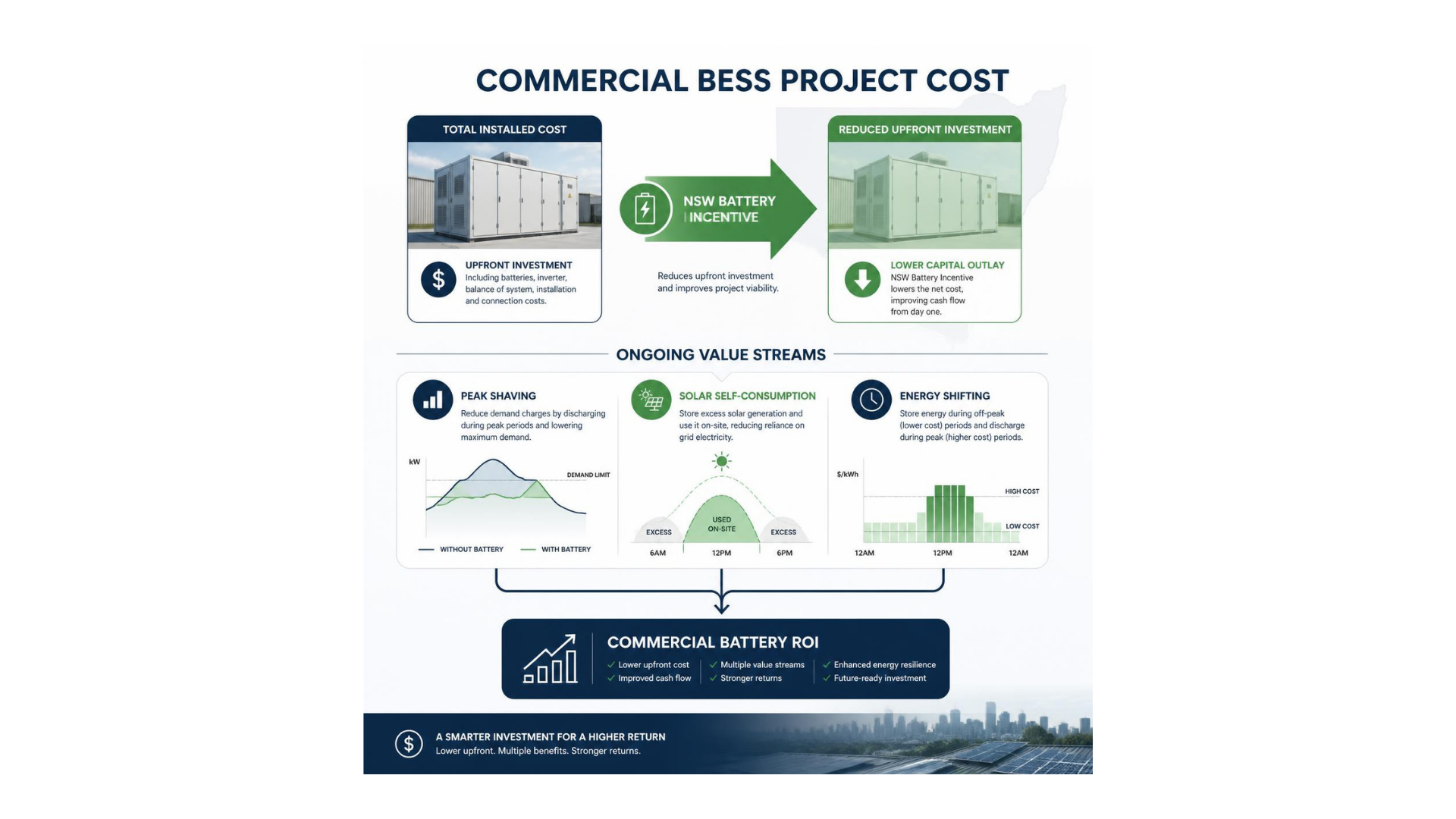
10. Solar Only vs Battery Only vs Solar + Battery
Businesses should also consider whether battery storage is actually the first investment they should make.
Solar only
Can be particularly attractive where the business has:
high daytime consumption, significant available roof area and strong solar self-consumption.
Battery only
May be worth investigating where the business has:
significant demand peaks, suitable tariffs, existing solar or specific energy-management requirements.
Solar + Battery
Can become particularly interesting where:
the business can generate substantial daytime solar, store excess generation and use the battery strategically during peak periods or later in the day.
The correct answer isn't universal.
It should come from the site's electricity data.
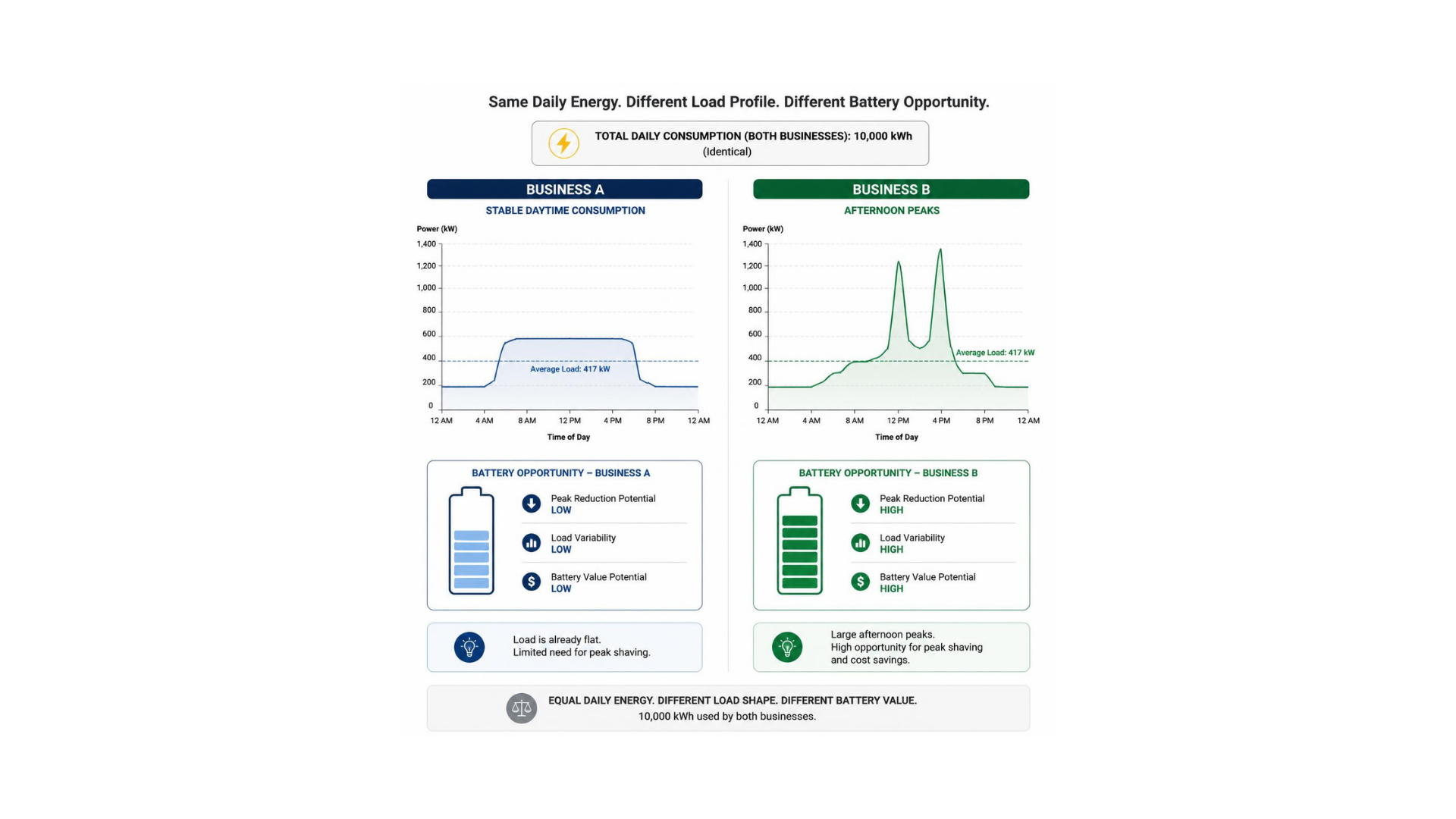
11. Don't Size a Commercial Battery From the Electricity Bill Alone
This is another common mistake.
A monthly bill may tell us:
how much electricity was consumed.
But it doesn't necessarily tell us enough about:
when it was consumed.
For commercial battery modelling, timing is critical.
A business consuming:
1,000,000 kWh annually
could have a completely different battery opportunity from another business consuming exactly the same amount.
That's why interval data is so valuable.
We want to see the shape of the site's electricity demand.
Not just the total.
12. So, Can a Commercial Battery Actually Save Your Business Money?
Yes — but not automatically.
A commercial battery can potentially reduce electricity costs through:
peak shaving
demand-charge management
increased solar self-consumption
energy shifting
and, depending on the system,
operational resilience.
But the strength of the investment depends on the site.
The correct commercial BESS process should therefore be:
Analyse electricity data
↓
Identify where value can be created
↓
Define what the battery needs to do
↓
Size battery power and capacity
↓
Assess applicable incentives
↓
Model savings and project economics
↓
Then decide whether to invest.
Not the other way around.
Is Commercial Battery Storage Worth It for Your Business?
If you're considering commercial battery storage, the starting point shouldn't be choosing a battery brand or asking for a generic price per kWh.
Start with your energy data.
Ador Energy can assess your electricity consumption, interval data, peak demand, existing or proposed solar and operational requirements to determine whether commercial battery storage makes financial sense for your site.
For NSW businesses, we can also assess how the new commercial battery incentives may apply to the proposed project.
Request a Commercial Solar & BESS Feasibility Assessment
Send us your latest electricity bills and available interval data, and we'll start by looking at the numbers.